

What Lash Extensions Are Best for Downturned Eyes? Styles, Curls & Mapping for a Lifted Look

Key Takeaways
The most effective lash design for downturned eyes moves the visual peak inward from the extreme outer corner rather than lengthening the very tip
Squirrel mapping, kitten mapping and modified cat-eye styles all build lift through the outer-middle of the eye before tapering the final section
Curl should be chosen to match natural lash growth direction and lid shape, not eye shape alone, and can vary across different zones of the same eye
Hybrid sets and hand-made volume fans allow lift to be added selectively without creating a heavy, dark outer corner
A personalised consultation, such as the one offered by Eyelash & Eyebrow Haus by Glamorous Lashes London, helps translate these mapping principles into a customised design
Downturned eyes have a soft, gentle quality, but many people wearing lash extensions want that outer corner to look a little more lifted and awake. Getting there has far less to do with picking the "right" style off a shelf and much more to do with understanding how length, curl and density interact with the eye's natural shape. In general, squirrel, kitten and modified cat-eye mapping can all work particularly well when the aim is lift, because the longest point can be positioned before the extreme outer corner and followed by a controlled taper.
The best choice still depends on the natural lashes, eye and lid shape, and the result the client wants to achieve. This guide sets out exactly where lift should be built, and where it should be pulled back, so the finished set works with the eye rather than against it. At Eyelash & Eyebrow Haus by Glamorous Lashes London, we approach every set this way, treating mapping as a design decision rather than a fixed formula.
Best Lash Extensions for Downturned Eyes at a Glance
Your goal | Best starting point | Key design choice |
Natural, subtle lift | Squirrel or kitten | Keep density soft and outer lengths controlled |
Lift through the outer-middle | Squirrel | Peak before the outer corner, then taper |
Soft lift with elongation | Kitten | Keep the flare controlled and taper the final section |
More feline elongation | Modified cat-eye | Peak before the extreme corner, then shorten the tail |
Rounder, more open look | Open-eye or doll-eye | Move the peak towards the centre |
Avoid | Extreme outer-corner length | Can reinforce the downward line |

Eyelash & Eyebrow Haus by Glamorous Lashes London
Book Lash Extensions for Downturned Eyes in London
Custom-mapped extensions designed to create lift, balance or soft elongation without forcing every downturned eye into the same shape.
What you get:
Ultra Fine Lashes
Custom mapping
Master Lash Technicians
No junior or trainee technicians
Why Outer-Corner Length Can Backfire

It feels intuitive to add the longest, boldest lashes right at the outer corner, since that is often where drama and elongation live in classic cat-eye styling. For eyes that already slope downward at the outer edge, though, this can be the exact opposite of helpful. Placing maximum length and weight at the point where the eye is already falling simply continues that downward line outward, making the droop more visible rather than less.
The fix sounds almost too simple: stop treating the extreme outer corner as the place for peak length. Instead, the strongest, longest lashes should sit slightly before that point, through what stylists often call the outer-middle zone, with a clear and deliberate taper as the line reaches the final corner. This single adjustment, moving the peak inward and shortening the tail, is the foundation of nearly every successful lash map for a downturned eye.
Getting this balance right takes more than a standard length chart. It calls for reading how an individual eye tilts, how the natural lashes grow, and how much lift the client actually wants, which is exactly what a proper consultation is designed to uncover.
How Downturned Eyes Change Lash Design

Reading eye tilt, brow position and natural growth
Downturned eyes are simply eyes where the outer corners sit visually lower than the inner or central eye line, giving a naturally soft or sleepy look. This is a completely normal variation in eye shape rather than something that needs correcting, but it does mean a few extra details deserve attention before any lengths get chosen. Eye tilt is the obvious starting point, though brow position matters just as much, since a low brow arch can flatten even a well-placed peak, while a higher arch gives the lift more room to register.
For the opposite eye tilt, see our guide to upturned eyes.
Natural lash growth direction is arguably the most overlooked factor of all. Two clients can both have the same degree of downturn at the outer corner, yet one might have outer lashes that already grow upward while the other's grow straight down or even slightly inward. That difference changes which curl and which length progression will actually read as lifted once the eyes are open, rather than just look good on a mapping chart.
This is also why we would not automatically use the same map on every client with downturned eyes. Eye width, lid shape, brow position, natural lash direction and strength, asymmetry and the amount of lift or drama wanted can all influence where we place the peak, how quickly we taper the outer corner and which curls and lengths we choose.
Why a traditional cat-eye map can exaggerate the droop
A traditional cat-eye map builds continuously toward the outer corner, with the longest, darkest lashes sitting right at the tip. On eyes without a downturn, this creates a striking, elongated finish. On a downturned eye, that same continuous build can simply extend the natural downward line even further, making the outer corner look heavier and lower rather than lifted.
This does not rule out cat-eye styling for downturned eyes; it only needs adapting. A modified version, where the peak sits further inward and the final section is deliberately shortened, can still deliver that elongated, feline finish without dragging the eye down. The distinction between a traditional cat-eye and a modified one is small on paper but significant in the mirror.
It also helps to separate lift from elongation when choosing a style. A client asking for a cat-eye may be picturing a more lifted appearance, while a traditional cat-eye is primarily designed to extend the eye outwards. During our consultation, we can establish whether the priority is lift, elongation or a combination of both before deciding where the longest lengths should sit.
Mapping Styles That Create Lift

Squirrel mapping: peak before the outer corner
Squirrel mapping is generally considered one of the most reliable starting points for a lifted downturned-eye set. The longest lashes sit in the outer-middle zone, often roughly beneath the arch of the brow, with a noticeable taper immediately afterward rather than a continued build to the corner. This creates the visual impression of upward movement precisely where the eye's own droop would otherwise take over.
The strength of squirrel mapping lies in how adaptable it is. It can be built softly for a natural, barely-there lift, or with more density and stronger curl for a more dramatic finish, all while keeping the same underlying principle: peak before the corner, then pull back.
Kitten and modified cat-eye options
Kitten mapping works as a softer take on the classic cat-eye. The flare still leans toward the outer third of the eye, giving that familiar elongated feel, but the peak itself is pulled inward and the very last section is tapered rather than left as the longest point. This suits clients who want some feline drama without losing the lifting effect.
A modified cat-eye takes a slightly bolder approach for those who want more obvious elongation. The longest point moves to roughly three-quarters of the way across the lash line instead of sitting right at the extreme corner, and the final section is reduced by a couple of length increments rather than continuing to build outward. It keeps the elongated cat-eye silhouette while stopping short of reinforcing the downturn.
Open-eye and doll-eye alternatives
Open-eye mapping shifts the emphasis further inward again, placing the longest lashes toward the centre of the eye and shortening the lengths at both corners. This creates a rounder, brighter, more awake appearance and tends to suit eyes with a more pronounced downturn, weaker outer lashes, or a lower brow position where a squirrel peak might not have enough room to register.
Doll-eye mapping takes this centre-focused idea even further, building the longest lashes through the middle of the lash line and tapering symmetrically toward both corners. It creates a rounded, open effect that avoids relying on the outer corner at all, which can be useful where the natural lateral lashes are particularly sparse or fine.
Choosing the Right Curl for Lift

Matching curl to natural lash direction, not eye shape
Curl choice deserves just as much thought as mapping, yet it is often decided purely on eye shape rather than what the natural lashes are actually doing. A lash curl works by directing the extension upward and outward, so its effect depends heavily on how the natural lash beneath it already grows. Straighter or downward-growing natural lashes typically need a stronger, more directional curl to achieve visible lift, while naturally upward-growing lashes may only need a gentle curve to avoid looking over-curled.
C and CC curls tend to give a soft, natural-looking lift and work well through the inner and central zones, where subtlety usually reads better than drama. Stronger CC or D curls can help create more visible elevation through the outer-middle peak zone, while L or M-style curls, with their straighter base followed by a sharp upward bend, are particularly useful for lashes that grow straight or downward, or for lids where a fold hides a more conventional curl shape.
Using different curls across different zones
No rule says one curl has to run across an entire set. Varying curl by zone often separates a genuinely lifted, natural-looking result from a set that simply looks curled. A softer curl through the inner corner, building to a stronger or more directional curl through the outer-middle peak, then easing back slightly toward the final tapered section, can create a far more convincing lift than uniform curl throughout.
This zone-by-zone thinking becomes especially important for anyone with mixed natural lash direction, such as upward-growing inner lashes paired with straighter or downward-growing outer lashes. Treating the whole eye the same way in that scenario risks under-correcting one side and over-correcting the other.
Classic, Hybrid or Volume for Downturned Eyes

Choosing a lash technique matters just as much as choosing a map, since density changes how strongly that map reads once it is finished. Classic extensions, applied one to one with each natural lash, suit clients with naturally dense lash lines who want clean, defined length without added fullness, though the final look still depends heavily on the client's own lash density. Hybrid sets, blending classic and volume fans, tend to offer the most flexibility for a lifted downturned-eye design, since fullness and lift can be adjusted independently rather than forcing one uniform density across the whole eye. Volume techniques, including lighter fan work, can also work well, provided the emphasis stays on maintaining fullness through the intended peak rather than letting the outer corner grow progressively darker and longer.
For a subtler finish, see our guide to natural-looking lash styles.
Why hand-made fans support a lighter, safer outer taper
The way a volume fan is constructed has a direct bearing on how well an outer taper can be controlled. Hand-made fans allow a technician to build precisely the right amount of fullness in each zone, tapering the outer corner smoothly without excess bulk or extra adhesive weight. Every volume fan is hand-made individually rather than pre-made, since pre-made fans are often heavier due to excess adhesive and can compromise the natural lashes underneath. That lighter, more controlled construction matters most exactly where a downturned-eye map calls for restraint: through that final outer section.
Preparing for a Personalised Lash Consultation
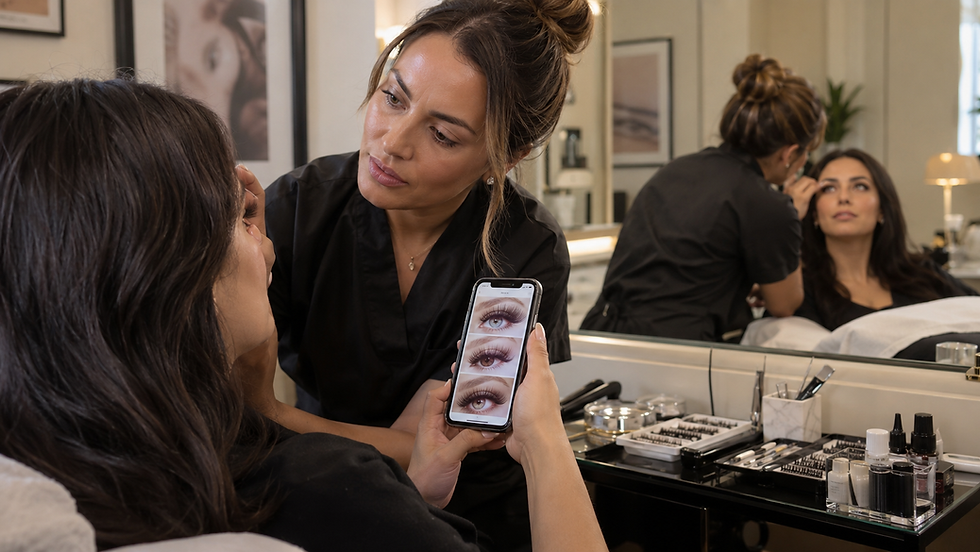
Our personalised consultation turns all of these mapping and curl principles into a plan built around one specific pair of eyes, rather than a generic style pulled from a chart. It helps to walk in with a clear sense of what "lift" actually means personally, since some clients want a natural, barely-noticeable correction while others are after a more dramatic, elongated finish. Neither goal is more correct than the other; downturned eyes do not need fixing, only styling to match what someone actually wants to see in the mirror.
A few practical steps can make that conversation far more productive:
Bring reference photos of lash sets that reflect the desired level of lift or elongation, rather than describing it in words alone.
Tell us whether the priority is a lifted appearance, greater elongation or a combination of the two.
Ask specifically where the longest lengths will sit on the map, and confirm whether the outer corner will be tapered or shortened.
Mention whether natural lashes seem to grow straight, upward or downward at the outer corners, since this affects curl choice as much as eye shape does.
Flag any asymmetry between the two eyes, since identical maps are not always the right approach for balanced results.
Be clear about whether the aim is a natural lift, a bolder elongated look, or simply refining the eyes' natural shape without heavy correction.
For general precautions, see eyelash extension safety guidance from EyeWiki and eye cosmetic safety guidance from the FDA.
The Lifted-Eye Mapping Principle

The core idea running through every mapping option covered here is straightforward: build the strongest visual lift through the outer-middle of the eye, then shorten and lighten the final section rather than letting it carry the most length and weight. Squirrel, kitten, modified cat-eye, open-eye and doll-eye maps all apply that same logic in slightly different ways, and curl should always follow natural lash direction and lid anatomy rather than eye shape alone. For an easy way to put these principles into practice, a personalised lash extension consultation can help translate this mapping approach into a set that suits one specific pair of eyes.
FAQs (Frequently Asked Questions)
What lash style is best for downturned eyes?
Squirrel and kitten maps are useful starting points when the goal is lift because the longest lashes sit before the extreme outer corner and taper towards the tail. A modified cat-eye can work when more elongation is wanted, while open-eye or doll-eye mapping can create a rounder, more open effect. The final choice should still be adjusted to the natural lashes and eye anatomy.
Are cat-eye lashes good for downturned eyes?
They can be, but a traditional cat-eye that keeps increasing in length all the way to the outer corner may emphasise the natural downturn. A modified cat-eye moves the peak inward and shortens the final section so the eye can still look elongated without placing maximum visual weight at the tail.
What curl is best for downturned eyes?
There is no single curl that suits every downturned eye. C or CC curls can create a softer lift, while stronger CC, D, L or M-style curls may be useful in selected zones when the natural lashes grow straighter or downward. Curl should be chosen around natural lash direction, lid anatomy and the intended result.
Are Classic, Hybrid or Volume lashes better for downturned eyes?
All three can work. Classic gives clean definition, Hybrid allows density to be adjusted more selectively, and Volume can add soft fullness around the intended peak. The map, curl, length distribution and outer-corner taper usually matter more to the lifted effect than the treatment name alone.
Can lash extensions make downturned eyes look more lifted?
Lash extensions can change the visual balance of the eye by moving the longest point inward, directing curl upward and tapering the extreme outer corner. They do not change the eye itself, but careful mapping can create a noticeably more lifted appearance.
What should I ask for at my lash consultation?
Explain whether you want lift, elongation or a rounder, more open result. Bring reference photos, ask where the longest lengths will sit, discuss whether the outer corner will be tapered, and mention anything you disliked about previous lash sets. We can then use that information alongside your natural lash direction and eye shape to plan the map.
Book Lash Extensions for Downturned Eyes in London
Custom-mapped extensions designed to create lift, balance or soft elongation without forcing every downturned eye into the same shape.


Comments