

What Lash Extensions Are Best for Upturned Eyes? Styles, Curls & Lengths That Flatter Your Natural Lift

Key Takeaways
Upturned eyes already have a natural upward lift - good lash design is about deciding where to place emphasis, not simply adding more lift.
There is no single best lash map for upturned eyes; the right choice depends on whether the goal is to enhance, balance, or soften the natural upturn.
Curl selection should follow the direction of the natural lashes, not just the eye shape - mixing curls across different zones often produces the most flattering result.
A soft cat-eye, squirrel, or kitten map each serve upturned eyes differently - keep reading to understand which fits your goal.
The team at Eyelash & Eyebrow Haus by Glamorous Lashes London offers personalised consultations for eye-shape-specific styling, tailoring every set to the individual.
Upturned eyes turn heads for exactly the right reasons - that natural feline slant is one of the most sought-after qualities in lash styling. But lash extensions change the rules. The question is no longer how to create lift. The question is what to do with the lift already there.
Best Lash Extensions for Upturned Eyes at a Glance
Your goal | Best starting point | Key design choice |
Enhance your natural lift | Soft cat-eye | Peak in the outer third with a controlled final taper |
Soften a pronounced upturn | Kitten or squirrel | Peak beneath the brow arch, then taper towards the tail |
Create a rounder, more open look | Doll or open-eye | Peak over the iris or centre of the eye |
Keep your natural shape | Natural map | Follow the existing lash line and natural proportions |
Add texture | Wispy version of your chosen map | Map controls shape; spikes add texture |

Book Lash Extensions for Upturned Eyes in London
Custom-mapped extensions designed to enhance, soften or balance your natural lift, rather than forcing every eye into the same shape.
What you get:
Ultra Fine Lashes
Custom mapping
Master Lash Technicians
Your Upturned Eyes Already Have the Lift - Here’s What That Means for Lash Design

Most lash maps are engineered to create an upward, elongated effect. When the eyes already tilt upward naturally, the usual logic needs rethinking. Blindly applying a dramatic cat-eye map to an already pronounced upturn can push the shape into territory that feels too sharp, too angular, or simply overdone. The smarter approach is to treat the upward tilt as one design variable among several - not as the complete brief.
Eye spacing, lid type, natural lash direction, and the client’s own lash strength all influence what will actually look flattering. Two people can both have upturned eyes and need entirely different maps. That nuance separates a skilled consultation from a generic lash booking.
What Actually Makes an Eye Upturned

An upturned eye has one clear characteristic: the outer corner sits visibly higher than the inner corner, creating an upward slant from inner to outer canthus. A simple way to check is to imagine a horizontal line running from the inner corner straight across. If the outer corner finishes above that line, the eye has an upward tilt.
Upturned is a description of eye tilt, not the complete shape of the eye. The same person might also have almond-shaped eyes, a hooded lid, close-set placement, or naturally downward-growing lashes. Each of those factors matters independently when planning a lash map.
Enhance or Balance? Choose Your Goal First
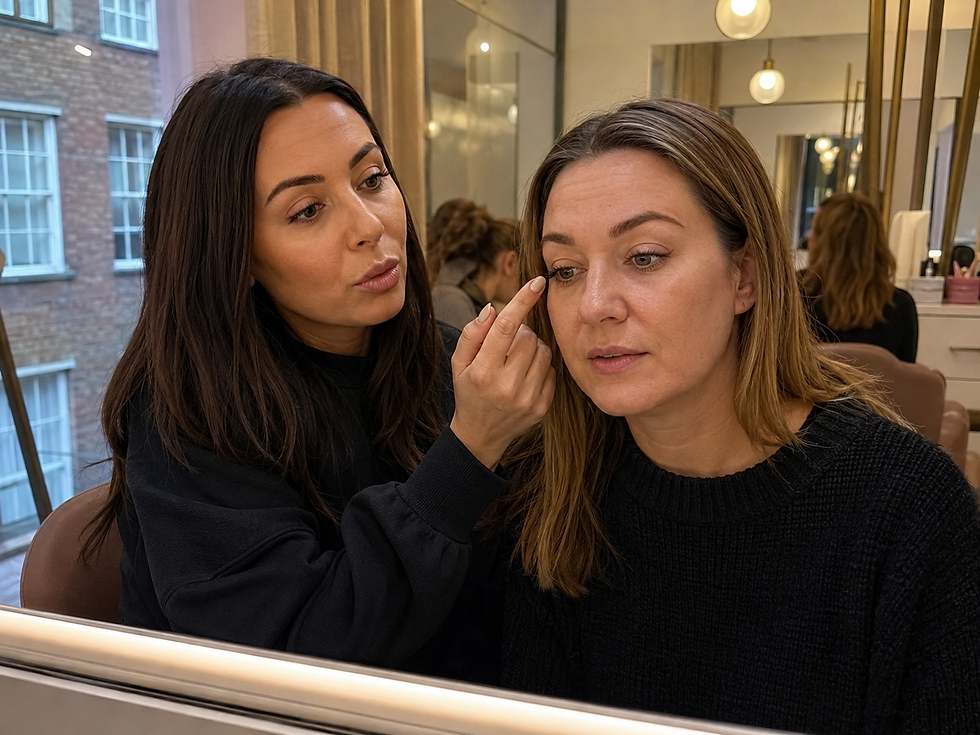
Before discussing specific curl letters or millimetre ranges, the most important decision is the design goal. Professional lash guidance varies on the best map for upturned eyes, with different recommendations addressing different styling goals. Some guidance recommends a squirrel map with a softer curl to avoid exaggerating the lift further, while cat-eye mapping is generally used to accentuate natural lift and create an elongated, feline appearance. Both are correct - for different briefs.
Enhancing the Natural Upturn
For clients who love their naturally feline shape and want extensions to honour it, a soft cat-eye map is the strongest starting point. It follows the direction the eye already travels - outward and upward - and adds controlled elongation to that sweep.
Balancing or Softening the Upturn
For clients who find their upturn feels too sharp, or who want a softer, more open result, a squirrel or kitten map shifts the visual peak before the outer edge. A doll or open-eye map takes this further, moving the longest lashes towards the centre to create a rounder appearance. The goal drives the map - always.
Best Lash Maps for Upturned Eyes

Soft Cat-Eye: Follow the Direction Your Eyes Already Want - But Keep It Controlled
A cat-eye map increases length progressively towards the outer portion of the eye, producing an elongated, wing-like silhouette. For upturned eyes that want to lean into their natural shape, this is an excellent fit. The key word is soft.
Technical cat-eye guidance often warns against loading the final outer natural lashes with the maximum extension length, as these lashes tend to be finer and excessive length can cause them to droop - the opposite of the intended effect. A flattering cat-eye on an upturned eye often involves a peak in the outer third, with a slight taper towards the very end of the lash line, to avoid an overly sharp or exaggerated look.
Best for: Mild-to-moderate upturns where the client wants a deliberately feline, elongated result.
Kitten & Squirrel: Lift Without Sharpening the Corner
Both kitten and squirrel maps share a defining principle that makes them particularly well-suited to upturned eyes: the longest lashes sit beneath the brow arch, not at the extreme outer corner. From that peak, the lengths taper downward towards the tail. The eye still reads as lifted and defined - but the gaze does not get pulled all the way to the outer point.
We recommend squirrel mapping with a softer curl for upturned eyes when the goal is not to lift the corners further. Squirrel styling can tone down a pronounced upturned shape without losing the elegant, lifted character entirely.
Best for: Pronounced upturns, clients who find conventional cat-eye extensions make them look too angular, or anyone whose final outer lashes are finer and less able to carry significant length.
Doll & Open-Eye: When Rounder Is the Goal
Open-eye and doll-eye maps place the longest extensions around the centre of the eye - roughly above the pupil - and taper towards both the inner and outer corners. The result is a larger, rounder, more symmetrical appearance. For upturned eyes, this is the most effective counterbalance to a strongly feline tilt.
Position this as a goal-specific option rather than a universal recommendation. If the client’s language in consultation includes words like softer, rounder, brighter, or less cat-eye, this map is worth discussing. An open-eye map can over-round an eye that is already very circular, so individual assessment always applies.
For clients who already like their natural upturned shape and simply want more definition, a natural map can follow the existing lash line without deliberately shifting the visual peak. This keeps the eye’s own proportions intact while adding length, darkness, and polish.
Can Wispy Lashes Work on Upturned Eyes?

Yes. The important distinction is that wispy describes texture, not the map itself. A wispy set can still follow a cat-eye, squirrel, kitten, natural, or open-eye shape. The spikes and varied lengths create a lighter, more textured finish, while the underlying map still determines where the eye appears longest and most lifted.
For upturned eyes, wispy texture can work particularly well with a soft cat-eye or squirrel map because it keeps the result airy while the peak placement controls how strongly the natural upturn is emphasised.
Peak Placement Depends on Your Chosen Map

One of the most practically useful concepts for upturned eyes is understanding where the longest lash should sit - not just how long it should be.
Outer corner peak (cat-eye): Maximises the natural cat-eye elongation; works best as a controlled, soft version rather than an extreme outer tail.
Under the brow arch (kitten & squirrel): Creates a lifted focal point before the corner, preserving a feline feel without extending the outer tip indefinitely.
Over the iris (doll & open-eye): Centres the visual weight, drawing attention away from the upturned corners and towards the middle of the eye.
For a pronounced upturn, the most flattering peak is often slightly before the eye’s outer edge. For someone who genuinely wants to maximise the cat-eye effect, the peak can sit further out - but the final outer lashes still need appropriate, proportionate length.
Choosing the Right Curl: B, C, or D
Why Natural Lash Direction Matters More Than Eye Shape
Curl letters describe the curvature of the extension fibre. Assigning a curl based solely on the label upturned eyes is an oversimplification. Professional guidance advises considering eye shape, eyelids, and desired style together before selecting a curl. Assessing the client from the side to observe how the natural lashes themselves lift and point is also recommended for accurate curl selection.
The more useful principle: eye tilt tells you where the silhouette should peak; natural lash direction tells you which curl can build that silhouette.
B curl: Soft and relatively natural. Useful for understated sets or for zones where the natural lashes already point upward - adding a stronger curl here would over-exaggerate the lift.
C curl: Versatile moderate lift. A reliable starting point for most upturned sets, particularly where natural lashes are straight or only slightly tilted.
CC curl: A step between C and D. Useful when direction varies across the eye and one section needs more lift than the rest.
D curl: Stronger, rounder, more dramatic. Best used selectively - for zones that genuinely grow downward, or for clients specifically requesting bold, wide-open drama.
When to Avoid D Curl on Upturned Eyes
D curl is not inherently wrong for upturned eyes - it depends entirely on where the natural lashes point and what the client wants. Applied uniformly across an already lifted lash line, it can push the outer corners into an exaggerated, almost theatrical look. For instance, if inner and outer lashes already curve upward but the centre is straighter, a C curl can work on the lifted edges and a CC curl can lift the centre, reserving stronger curl only for areas that genuinely need it.
Length Progression, Not a Fixed Millimetre Map

No single millimetre sequence suits every upturned eye. The maximum extension length must be determined by the health, strength, and thickness of the individual natural lash - not by a predetermined chart. Professional mapping guidance often suggests extensions should not exceed approximately 3mm longer than the natural lash, and no more than 50% additional length.
As an illustrative guide, natural-to-medium sets for upturned eyes might work within an 8-13mm progression from inner corner to peak, with the tail length determined by the chosen map. A squirrel map might taper the outer corner back to 7-9mm even when the peak reaches 12-13mm. A soft cat-eye might taper only slightly. Length decisions should always follow from natural lash assessment, not from a number seen online.
Classic, Hybrid, or Volume: Which Suits Upturned Eyes?

The lash technique changes density and texture, not the fundamental silhouette. The map controls the shape; the technique controls how full and finished it appears.
Classic: One extension per natural lash. Clean, defined, mascara-like. Excellent for upturned eyes with a reasonably full natural lash line where the shape should remain crisp and visible.
Hybrid: A mix of Classic extensions and Volume fans. Produces a more textured, broken top line - particularly versatile for soft wispy cat or squirrel results, and useful for disguising small lash gaps.
Volume: Multiple lightweight fibres in hand-crafted fans. Adds density and fluffiness. Works well where natural lash density is lower, but the outer taper of the chosen map should still be respected - filling the tail indiscriminately defeats the purpose of considered peak placement.
For clients asking for something soft, wispy, and lifted, Hybrid is often the easiest technique to position as the versatile middle ground - Classics provide definition and texture spikes, while fans add controlled fullness.
FAQs (Frequently Asked Questions)
What lash style is best for upturned eyes?
There is no single best style for every upturned eye. A soft cat-eye can emphasise the natural lift, kitten or squirrel mapping can soften a pronounced upturn, and doll or open-eye mapping can create a rounder, more open appearance.
Are cat-eye lashes good for upturned eyes?
Yes, especially if you want to emphasise the naturally feline shape. A softer cat-eye with the peak in the outer third and a slight taper at the very end is often more flattering than putting maximum length on the outermost lashes.
What curl is best for upturned eyes?
The best curl depends on the direction of your natural lashes as well as your eye shape. B or C curls can suit naturally upward-growing lashes, while CC or D may be useful selectively where more lift is needed. Different curls can also be mixed across the lash line.
What lash length is best for upturned eyes?
There is no universal length. The safe maximum depends on the strength, thickness, and length of your natural lashes. The more important design decision is where the longest lashes sit, because that determines whether the set enhances, softens, or balances the upturn.
Can wispy lashes suit upturned eyes?
How can lash extensions make upturned eyes look rounder?
A doll or open-eye map moves the longest lashes towards the centre of the eye, usually around the iris, rather than concentrating length at the outer corner. This shifts the visual focus inward and can create a softer, rounder appearance.
What to Ask for at Your Lash Consultation

Going into a lash consultation knowing what to communicate makes a meaningful difference to the outcome. A skilled technician will assess the whole eye - not just tick the upturned box - but having clarity on the desired result helps focus the conversation.
Describe the goal in plain language: Saying you want to emphasise your natural cat-eye shape versus wanting your eyes to look softer and more open will lead to very different maps.
Bring reference images: A photo of a finished set that feels right is worth more than any technical term.
Ask about peak placement: Where will the longest lashes sit - outer corner, under the brow arch, or over the iris?
Discuss curl selection by zone: Ask whether the technician plans to mix curls based on natural lash direction, rather than applying one curl uniformly.
Be honest about what has not worked before: If a previous cat-eye set felt too angular, say so - that information directly shapes the new map.
The goal is to arrive informed, not to dictate the technical method. A good technician will use that context alongside their own assessment to build a set that genuinely flatters the individual eye.
At our London salon, we use personalised consultations and bespoke lash mapping to tailor every set to your eye shape, natural lashes, and preferred result. Our Master Lash Technicians do not use junior or trainee technicians, so your design is planned and applied by an experienced lash specialist rather than treated as a one-size-fits-all set.
Book Lash Extensions for Upturned Eyes in London
What you get:
Ultra Fine Lashes
Custom mapping
Master Lash Technicians


Comments