

Wispy vs Classic Lashes: Natural Look, Styles, Lengths, Retention & Aftercare
Key Takeaways
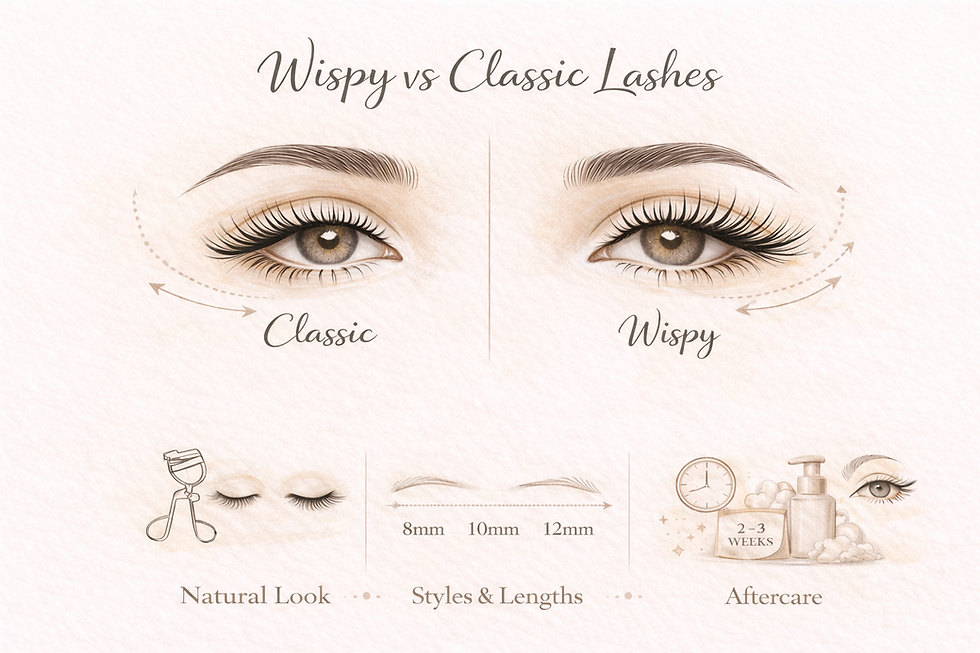
Classic lashes use a 1:1 application method (one extension per natural lash), whilst wispy is a styling outcome that creates textured, feathery effects through varied lengths
Both styles typically require maintenance fills every 2-3 weeks to maintain their full appearance as extensions shed naturally with your lash cycle
The "natural" look depends more on length choices and diameter selection than whether you choose classic or wispy styling
Proper mapping based on your eye shape dramatically impacts how flattering either style appears
Keeping lashes dry for 24-48 hours after application and using oil-free products are crucial for both styles' longevity
Choosing between wispy and classic lash extensions often feels overwhelming, especially when everyone seems to have different definitions of what each style actually delivers. The confusion deepens when searching online reveals contradictory advice about which looks more "natural" or lasts longer. Understanding the fundamental differences between these approaches - and how they're tailored to your unique features - makes all the difference in achieving lashes you'll love.
Wispy vs Classic Lashes Quick Comparison
Feature | Classic Lashes | Wispy Lashes |
What it is | A 1:1 lash extension method with one extension applied to one natural lash | A styling effect that creates soft texture through mixed lengths and strategic spikes |
Overall look | Clean, even, polished | Textured, feathery, more dimensional |
Best for | People who want subtle definition and a mascara-like finish | People who want more movement, separation, and a softer textured finish |
Can it look natural? | Yes, very natural with conservative lengths and light diameters | Yes, when the contrast between base and spikes is kept soft |
Lash pattern | More uniform across the lash line | Intentional variation with longer pieces placed throughout |
Customisation | Adjusted through curl, length, diameter, and mapping | Adjusted through base length, spike length, spacing, and mapping |
Eye shape impact | Works well for most eye shapes when mapped properly | Also works well for most eye shapes, especially when texture is placed strategically |
Maintenance | Usually needs infills every 2–3 weeks | Usually needs infills every 2–3 weeks |
Best choice if you want the most even look | Yes | No |
Best choice if you want more texture | No | Yes |

Book Classic & Wispy Lash Extensions in London
Ultra-Fine extensions custom-mapped to your features for a natural finish.
What you get:
Ultra Fine Lashes
Custom mapping
Results that last 4+ weeks
What's the Difference Between Classic & Wispy? Application Method vs Styling Outcome

Classic lashes represent a specific application technique: the 1:1 method where one extension attaches to each natural lash. This creates definition and length whilst maintaining the natural lash pattern, often described as achieving a "mascara effect but better." The result tends towards uniformity, with each lash receiving equal attention for a polished, clean finish.
Wispy lashes, however, describe a styling outcome rather than an application method. This approach creates intentional texture through varied lengths, with longer "spikes" placed strategically over a shorter base layer. Professional technicians explain that wispy effects can be achieved using classic 1:1 techniques, hybrid methods, or volume applications - the key lies in the deliberate length variation and mapping strategy.
The distinction matters because wispy styling can be subtle or dramatic, depending on how much contrast exists between the base and spike lengths. A gentle wispy effect might feature spikes 2-3mm longer than the base, whilst more textured looks create greater length variation (2-4mm difference) for that coveted "feathery" appearance.
Does Wispy or Classic Create a More Natural Look?

Classic Lashes Natural Advantages
Classic lashes excel at creating natural-looking enhancement when applied with conservative length choices and appropriate diameter selection. Using lighter diameters (0.10-0.12mm) and staying within 2-3mm of natural lash length produces what many consider the most predictably natural result. The uniform application creates smooth graduation across the lash line without dramatic peaks or valleys.
The "mascara effect" reputation of classic lashes stems from this consistency. Each lash receives equal enhancement, mimicking what well-applied mascara achieves but with superior longevity and no daily application hassle. For those seeking subtle definition that others might assume are naturally gorgeous lashes, classic applications with restrained specifications often deliver exactly that effect.
When Wispy Can Look Natural Too
Wispy styles achieve natural results when the base layer remains light and spikes are placed thoughtfully rather than randomly. The key lies in controlled contrast - shorter spikes with intentional spacing can create gentle texture that mimics natural lash variation whilst avoiding the "strip lash" appearance some associate with wispy styles.
Natural wispy effects work particularly well when the base lengths suit your natural lashes and spikes add just enough variation to create movement. This approach can actually appear more natural than perfectly uniform classic sets, as natural lashes rarely grow to identical lengths anyway.
Wispy Vs Classic Mapping and Length Recommendations by Eye Shape

1. Hooded Eyes: Conservative Lengths with Lift-Forward Curls
Hooded eyes benefit from conservative length choices (typically 8-12mm range) to avoid extensions hitting the brow bone or appearing overwhelming against limited lid space. L-curl or stronger lift-forward curls work exceptionally well, as the straight base section sits comfortably against hooded lids whilst the curved portion creates the desired lift effect.
Natural or doll-eye mapping suits hooded eyes well, and cat-eye extensions can also be effective in creating a lifted, elongated effect, counteracting any natural droopiness. Both classic and wispy styles work well when lengths remain sensible and curls are chosen to complement the lid structure rather than fight against it.
2. Downturned Eyes: Squirrel Mapping for Natural Lift
Downturned eyes require thoughtful mapping to create lift without appearing unnatural. Squirrel mapping - where the longest lengths sit in the outer-centre area rather than the very outer corner - provides gentle upward emphasis whilst avoiding the "sad" effect that can occur with overly long outer corners.
Classic applications with squirrel mapping create elegant lift, whilst wispy styles can enhance this effect through strategic spike placement in the lifting zones. The key lies in avoiding heavy emphasis on the outer third, instead focusing length and curl choices on areas that naturally counteract the downward angle.
3. Close-Set Eyes: Cat Eye Emphasis on Outer Third
Close-set eyes benefit from cat-eye mapping that draws attention outward, creating the illusion of wider-spaced features. This involves gradually increasing lengths towards the outer third whilst keeping inner corner lengths conservative. Both classic and wispy applications work beautifully with this approach.
Wispy styles can be particularly effective for close-set eyes, as the textured effect draws attention to the overall lash design rather than the spacing between features. Strategic spike placement in the outer areas enhances the widening effect whilst maintaining natural-looking results.
4. Wide-Set Eyes: Doll Eye Focus on Centre Length
Wide-set eyes often suit doll-eye mapping, which emphasises centre lengths to draw attention inward and create a more balanced appearance. This approach opens the eye whilst creating harmony between features that might otherwise appear disconnected.
Classic doll-eye sets create beautiful opened effects, whilst wispy applications can enhance this through centre-focused spike placement. The key lies in tapering lengths towards both inner and outer corners whilst maintaining generous centre emphasis for that sought-after "wide awake" appearance.
Classic & Wispy Lash Retention?

The 2-3 Week Fill Reality
Both classic and wispy extensions follow the same fundamental retention timeline: most clients need refills every 2-3 weeks to maintain fullness and symmetry. This timeline stems from the natural lash growth cycle, where individual lashes continuously shed and renew over a 6-8 week period.
The "2-3 week rule" exists because by this point, enough extensions have shed naturally that gaps become noticeable and the overall look appears less polished. Wispy styles might show gaps more obviously due to their textured nature, whilst classic sets tend to thin more gradually, but both require similar maintenance schedules for optimal appearance.
Factors That Affect Your Retention
Natural lash growth speed varies significantly between individuals, with faster-growing lashes requiring more frequent maintenance. Environmental factors like humidity affect adhesive curing, whilst lifestyle choices - particularly oil exposure and cleansing habits - dramatically impact how long extensions maintain their strong bond.
Quality application techniques also influence retention significantly. Proper isolation, appropriate extension weight for each natural lash, and optimal adhesive application create the foundation for good wear time. However, even perfect application cannot overcome poor aftercare or natural factors like hormonal changes that affect lash growth patterns.
Essential Aftercare for Classic & Wispy Eyelash Extensions

First 24-48 Hours: Keep Them Dry
The critical dry period immediately after application allows adhesive to fully cure and achieve maximum bond strength. Most professional systems require 24 hours minimum, though some specify up to 48 hours for complete setting. This means avoiding not just water, but steam from showers, saunas, or even hot beverages close to the face.
During this period, extensions remain vulnerable to displacement or bond weakening. Even gentle moisture exposure can compromise the adhesive before it reaches full strength, potentially leading to premature shedding or uneven retention patterns that become apparent in the following weeks.
Regular Cleansing Routine with Oil-Free Products
Oil-free cleansing daily (or at least 2-3 times weekly) removes makeup residue, natural oils, and environmental debris that can weaken extension bonds over time. Using gentle, directional cleansing motions from base to tip prevents tangling whilst ensuring thorough cleaning between extensions where buildup commonly occurs.
Foaming, lash-specific cleansers work most effectively, as their formulation targets the types of buildup that affect extensions without introducing oils or harsh surfactants. Regular cleansing actually extends wear time by maintaining the clean environment extensions need for optimal adhesion.
Daily Brushing for Shape and Longevity
Gentle daily brushing with a clean spoolie maintains extension alignment and prevents tangling, particularly important for wispy styles where texture can become chaotic without proper maintenance. Brushing when extensions are completely dry - never when damp - preserves both the curl pattern and extension positioning.
This simple habit prevents the "messy" appearance that can develop as extensions naturally shift during sleep or daily activities. For wispy styles especially, consistent brushing maintains the intentional texture pattern that makes the style look professionally maintained rather than haphazard.
FAQs (Frequently Askes Questions)
What’s the difference between wispy and classic lashes?
Classic lashes are a method. Wispy lashes are a style.
Classic lashes use one extension per natural lash for a smooth, even result. Wispy lashes use mixed lengths and longer spikes to create a softer, textured look.
Should I get classic or wispy lashes?
Get classic lashes for a cleaner look, or wispy lashes for a more textured look.
Classic suits clients who want polished, even definition. Wispy suits clients who want softness, movement, and more visible separation.
Do classic or wispy lashes look more natural?
Classic lashes usually look more naturally even, but soft wispy lashes can also look natural.
The final result depends on the length, curl, diameter, and mapping, not just the style name.
Book Your Perfect Wispy or Classic Lashes in London

Whether classic or wispy appeals more to your aesthetic preferences, the success of either style depends heavily on expert application, appropriate mapping for your features, and realistic length choices that complement your natural lashes. Understanding these fundamentals helps you communicate effectively with your lash technician and set appropriate expectations for both the initial result and ongoing maintenance requirements.
The choice between classic and wispy often comes down to personal preference and lifestyle factors rather than absolute superiority of either approach. Both can look natural with proper execution, both require similar aftercare commitment, and both deliver beautiful results when matched thoughtfully to your unique features and goals.
Ready to discover which lash style suits you perfectly? Book your consultation with the expert technicians at Glamorous Lashes London for personalised mapping and styling that enhances your natural beauty.


Comments