

London's Best Natural Lash Extensions? 5 Signs of a Subtle, High-Quality Set

Key Takeaways
A genuinely natural-looking lash set depends on personalised mapping, restrained length and curl, believable density, clean safe application and a varied portfolio, rather than a single named style
For a subtle result, length, curl and weight should be chosen to suit the client's own lashes and desired finish rather than pushed to the longest or strongest option available
Proper isolation of each individual natural lash before applying an extension is essential for comfort and long-term lash health
No single technique guarantees a natural result; the stronger quality test is whether the technician can adjust the design, density and weight to the client's own lashes
London residents booking lash extensions can ask specific consultation questions before committing to a technician - the article breaks down exactly what to ask
Booking lash extensions for the first time, or trying a new studio after a disappointing set, often comes down to one worry: will the result look like real lashes, or will it look obviously done? Understanding what separates a subtle, well-mapped set from an artificial-looking one puts that decision back in the client's hands.
Quick Checklist: How to Choose Natural Lash Extensions in London
Check | Ask this | Good sign | Warning sign |
Mapping | How will you adapt the lash map to my eyes and natural lashes? | Lengths, curls and placement are tailored to you | The same map is offered to everyone |
Length, curl & weight | How will you decide what my natural lashes can comfortably support? | The technician explains why the choices suit your lashes and desired finish | Longest or strongest options are recommended by default |
Density & technique | Would Classic, Hybrid or Volume best suit the natural result I want? | Technique and density are chosen around your lashes and preferred finish | One technique is described as automatically the most natural |
Application | How do you check isolation and make sure lashes are not stuck together? | Careful isolation, finishing checks and attention to comfort | Clumping, pulling or discomfort is treated as normal |
Portfolio | Can I see subtle sets on different clients and from different angles? | Varied eye shapes, densities, close-ups and full-face examples | Only one repeated look, one angle or heavily edited images |
Eyelash & Eyebrow Haus by Glamorous Lashes London
| Master Lash Technicians, Personalised consultation, Bespoke lash mapping, Careful isolation, Classic, Hybrid & Volume options | We tick the key boxes above: personalised design, appropriate length and weight, believable density, careful application and varied natural results. |

Natural Lash Extensions at Eyelash & Eyebrow Haus by Glamorous Lashes London
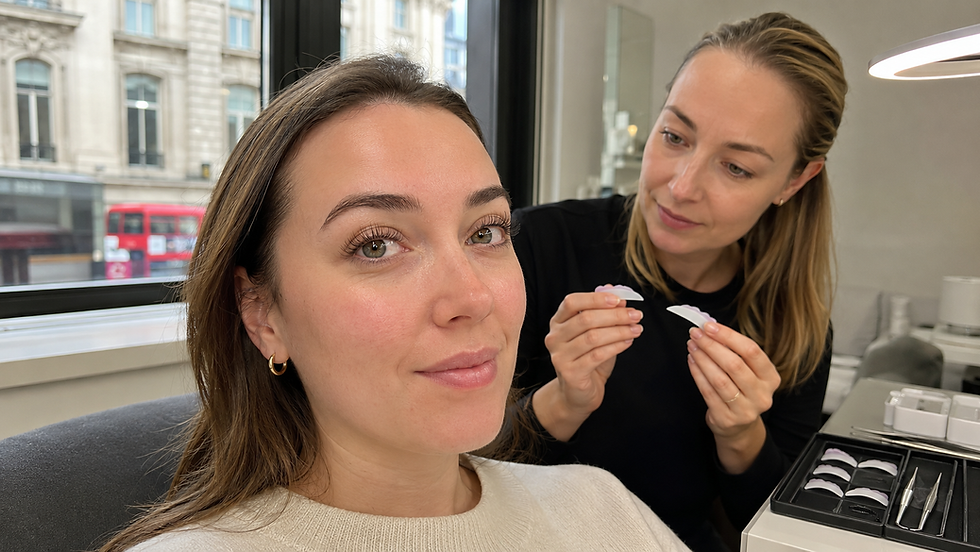
Subtle lashes should still look like you. We design each set around your natural lashes, eye shape and preferred finish.
What you get:
Master Lash Technicians
Personalised consultation
Bespoke lash mapping
Careful isolation and finishing
Why 'Natural' Isn't One Fixed Look

Asking for "natural lashes" sounds like a simple request, but it means something different for every eye. Two clients can walk into the same consultation, use the exact same word, and walk out with completely different lengths, curls and densities, and both results can be correct. The word describes a relationship between the extensions and the person wearing them, rather than a fixed product on a shelf.
This is why the most useful way to judge a set is not by style name alone. Classic, hybrid and volume techniques can all look natural or all look overdone, depending on how they are applied. A restrained hybrid on one client might read as more believable than a heavy-handed classic set on another, because the choices behind it were fitted to that person's own lash line, eye shape and lifestyle.
Recognising the difference between "light" and "natural" matters too. A sparse set is not automatically a natural one, and a full set is not automatically a fake one. The signs below focus on the decisions a technician makes before and during application, since those decisions are what actually determine whether a set flatters the eyes or announces itself as extensions.
Sign 1: A Map Built Around Your Own Lashes

Lash mapping is the process of planning different lengths, curls and thicknesses across the lash line before any extension goes on. A technician working from a genuine map responds to the shape of the eye, the direction the natural lashes grow, and how much length and weight those lashes can actually support. A technician who skips this step and applies the same pattern to every client, regardless of what they see in front of them, is working from a template rather than a plan.
Questions to ask before booking
A short conversation before the appointment reveals a lot about how a technician thinks. Useful questions include:
What would you change about this inspiration photo for my own eye shape and natural lashes?
How will you decide where to place the longest lashes?
Will my map look different from the last client's, and if so, how?
A specific, thoughtful answer, one that mentions the individual eye or lash condition, signals real customisation. A vague answer that could apply to anyone is a sign the map may not be personalised at all. At Eyelash & Eyebrow Haus by Glamorous Lashes London, this is why we treat "natural" as a consultation outcome rather than a preset style: an inspiration photo can guide the conversation, but the final design still needs to be tailored to the client in front of us.
Your natural lashes, eye shape and features matter
Eye shape, eyelid structure, and the length, density and condition of natural lashes all influence what a flattering, wearable set should look like. A rounder eye might benefit from a different length distribution than an almond-shaped one, and sparse natural lashes may need a different approach altogether from a naturally dense lash line. None of this can be assessed from a photograph alone, which is exactly why an in-person consultation, rather than a copy-paste booking form, tends to produce better results.
Sign 2: Length, Curl and Weight Are Carefully Chosen

Once the map is right, the specific measurements chosen for each extension either support that plan or undo it. Length, curl and diameter work together, and getting even one of these wrong can make an otherwise well-planned set look heavier or more artificial than intended.
Why longer or curlier isn't more flattering
More length or a stronger curl does not automatically mean a more flattering, eye-opening result. For a genuinely natural finish, the proportions should make sense against the client's own lashes and features, so the eye looks more defined rather than visibly extended. Inner-corner lashes will usually call for a more restrained approach than stronger areas of the lash line, while curl should be chosen for the client's natural lash direction and the effect they want.
A softer curl may create a more understated finish on one person, while another client may need a different curl to achieve the same visual effect. Neither choice is automatically better. The important sign is that the technician can explain why a particular length and curl suit the natural lashes and the desired result rather than simply defaulting to the longest or curliest option available.
Why the natural lashes themselves affect what can be applied
The natural lash is doing the actual work of carrying an extension all day, so its condition sets real limits on what can be applied safely and effectively. Finer diameters, generally at the lighter end of the classic range, blend more easily onto delicate lashes without adding excess weight, while thicker extensions add definition but increase the load the natural lash has to support. A technician who asks about lash health, recent lash history and any breakage before recommending a length or thickness is working with this reality rather than around it.
Sign 3: Density and Styling Look Believable, Not Uniform

Natural lashes are never perfectly uniform from one corner of the eye to the other, so a set that looks convincingly natural should not be either. The most telling detail in a finished set is often the transition between the inner corner, the main body of the lash line and the outer corner.
Classic, hybrid or volume: matching the technique to the result
No single technique guarantees a natural look, because technique is a tool rather than a promise. Classic extensions, where one extension is attached to one natural lash, can create understated definition. Hybrid sets blend classic and volume work, while carefully judged volume can also create a very soft finish using multiple fine extensions in a fan. The right choice depends on the client's natural lashes and how full, soft or textured they want the finished line to appear, rather than which technique sounds most "natural" on a treatment menu.
At Glamorous Lashes London, we hand-make our volume fans individually, which gives our technicians direct control over fan size and density during the appointment. Handmade fans are not, by themselves, proof of a better set; appropriate weight, isolation and placement still matter.
Natural-looking transitions and texture
A believable set generally shows a gradual build in length and density moving from the inner corner outward, rather than an abrupt jump from very short to very long. Deliberate variation in length and thickness, sometimes described as a wispy or textured finish, can mimic the slightly irregular way real lashes grow. An unbroken, uniformly dark line with no variation tends to read as a strip lash rather than an individual's own lash line, even from a distance.
Sign 4: Clean, Comfortable, Safe Application

A subtle-looking set can still be applied poorly, and the technical quality of the application affects both comfort and long-term lash health. This sign matters most beyond appearance, because it protects the natural lashes underneath.
Why isolation protects your natural lashes
Isolation means separating each natural lash individually before an extension is attached to it, so that neighbouring lashes are not accidentally glued together. Since natural lashes grow and shed on their own individual cycles, lashes that are stuck together can pull uncomfortably as one continues growing while its neighbour is ready to shed. Careful isolation, followed by a check through the finished set for any "stickies," is a basic but essential marker of technical skill, even though it has nothing to do with how the set looks in a photo.
What good application should (and shouldn't) feel like
Comfort is something to pay attention to, not something to endure for the sake of the finished look. Persistent stinging, pulling, pinching or watering during treatment should be raised with the technician rather than ignored. Before booking, ask how they check for lashes that have become stuck together, what they do if discomfort develops during the appointment, and how they decide whether the proposed length and density are appropriate for your natural lashes.
Treatment time alone is not a reliable test of quality: the more useful question is whether enough care is given to consultation, isolation, application and finishing checks. Visible clumps at the base, lashes that feel stuck together, or immediate heaviness and tightness are all reasonable reasons to ask more questions.
Sign 5: A Portfolio That Shows Real Variety

A single, heavily edited "signature look" repeated across every photo in a portfolio says very little about a technician's actual skill. What matters more is whether that same technician can produce genuinely different, appropriately restrained results across a range of real clients.
What to look for across different clients
A useful portfolio shows more than glamorous, front-facing shots taken in perfect lighting.
Helpful signs include:
Multiple clients with visibly different eye shapes and natural lash densities
A mix of full-face images, closed-eye close-ups and side or three-quarter angles
Subtle, everyday-wearable sets shown alongside fuller or more dramatic ones, so the difference between styles is clear
Photos that can be attributed to the specific technician being booked, particularly in a studio with several artists
Look at the portfolio at two distances. Close-up and closed-eye photographs can help you assess separation, transitions and styling detail, while full-face or wider images show whether the lashes actually look subtle in proportion to the client's features. Neither view tells you everything about the application, but together they are more useful than a feed made up only of extreme close-ups or highly posed finished shots.
At Eyelash & Eyebrow Haus by Glamorous Lashes London, we use our gallery as inspiration rather than a catalogue of fixed looks to copy. During consultation, we talk through the finish a client wants and adapt the design to their own lashes and features. That combination of varied examples and an individual consultation is more useful than promising that the same "natural" set will suit everyone.
The Bottom Line: How to Book a Subtle Set With Confidence

Judging whether a lash studio can deliver a genuinely natural result comes down to five checkable signs rather than a single style name or price point. A personalised map, sensibly restrained length and curl, believable density with real transitions, clean and comfortable application, and a varied, honest portfolio together give a much clearer picture than any one of them alone.
None of these signs works in isolation. A beautiful photograph cannot prove what happened during application, while technical skill alone does not guarantee that the finished shape will suit the person wearing it. Booking with confidence means asking direct questions, looking at both close-up and full-face portfolio examples, and choosing a technician who can explain how the design will be adapted rather than simply promising to copy a photograph.
At Eyelash & Eyebrow Haus by Glamorous Lashes London, every appointment includes a personalised consultation to discuss the look you want before the set is designed. If your goal is a subtle result that looks like your own lashes, only more polished, that consultation is the place to start.
FAQs (Frequently Asked Questions)
Which lash extensions look the most natural?
There is no single technique that is always the most natural. Classic, Hybrid and carefully judged Volume can all create a subtle result when the length, curl, density and mapping are tailored to the client.
Are Classic lashes always more natural than Hybrid or Volume?
No. Classic lashes can create understated definition, but a light Hybrid or soft Volume set may look more natural on another client. The better test is whether the technique is chosen around your natural lashes and the finish you want.
How can I tell if lash extensions may be too heavy for my natural lashes?
You cannot reliably judge appropriate lash weight from a finished photograph alone. Ask how the technician assesses your natural lashes and how they choose length, diameter and density for what your lashes can comfortably support.
What should I ask before booking natural lash extensions in London?
Ask how the lash map will be customised, how length, curl and density will be chosen, how isolation is checked, and whether you can see genuinely subtle results on different clients.
Can portfolio photos prove that a lash set was applied safely?
No. Portfolio photos can help you judge styling, transitions, variety and how subtle the result looks in proportion to the face, but they cannot prove every technical detail of the application. Use portfolio evidence alongside consultation questions and comfort during treatment.
Natural Lash Extensions at Eyelash & Eyebrow Haus by Glamorous Lashes London
Subtle lashes should still look like you. We design each set around your natural lashes, eye shape and preferred finish.


Comments